The Touchline, the Try Line and the Space Between
Rugby pitch markings make the field easier to read, helping you locate boundaries, scoring areas and tactical space as play moves across the grass.
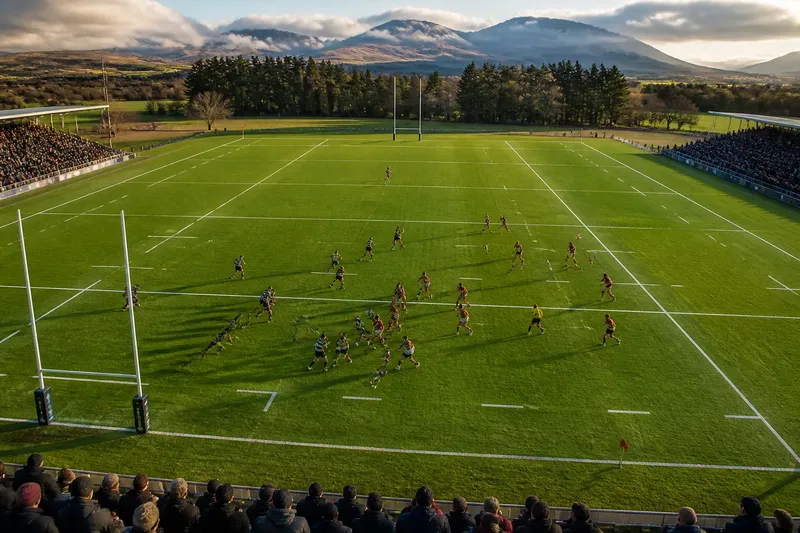
Rugby pitch markings make the field easier to read by showing where play can go, where a score is made and how the important areas relate. Start with the touchline, try line and marks between them: together, they turn the grass into a map of boundaries and space.
Where does the playing area begin and end?
The touchlines mark the long sides of the field of play, while the dead-ball lines mark its ends. Together, they frame the rectangular playing area and give every movement a boundary.
The in-goal area lies beyond each try line but within the dead-ball line and touch-in-goal lines. A player carrying the ball towards the end of the pitch is therefore approaching a sequence of distinct spaces, not one broad scoring zone.
The touchline helps the eye judge width, while the try and dead-ball lines establish the destination and the space beyond the field of play. A pass towards touch may gain ground sideways while leaving less room for the next phase.
What does the try line tell you?
The try line separates the field of play from the in-goal area. It is a visual threshold: a team can score a try by grounding the ball in the in-goal area, subject to the Laws of the Game. The line also signals a change in the defenders’ task, as they protect the space behind it as well as contesting territory.
The gap between the try line and dead-ball line is the in-goal area. A player may ground the ball there, but the dead-ball line and touch-in-goal boundaries mark the limits of that space. This helps explain why a run near the corner can feel different from a direct charge towards the posts: the available room changes with the angle.
Imagine a team attacking near the right touchline with a defender closing in. If the carrier turns infield before reaching the try line, the open gap towards the middle may become easier to see; if the carrier stays wide, the touch-in-goal boundary becomes more relevant. The markings do not reveal what the player will choose, but they make the options visible.
How do the halfway and 22-metre lines organise distance?
The halfway line runs across the pitch, dividing its length into two territorial halves. It gives spectators a quick reference for which side of the field the ball occupies and offers a simple way to describe territory without following every phase.
The 22-metre lines sit nearer each end and mark important zones. They help viewers orient themselves around common tactical situations, including kicks and restarts, and show when a team has moved from the middle of the field towards a scoring end. These intermediate landmarks make distance easier to judge.
The lines also help the eye compare position and direction. A team can be in the opposing half but still far from the 22; another can be near the try line while pressed towards a touchline. Each marking supplies one coordinate, while the full pattern gives a fuller picture.
What do the transverse lines and short marks add?
The pitch includes further transverse markings, such as the 10-metre and 5-metre lines. They break up long stretches of grass into smaller visual intervals and help locate restarts, set pieces and distances.
Short dash marks near the touchlines and elsewhere can seem minor, but they belong to the same system. They help players and officials identify positions associated with particular restarts and set-piece arrangements. For a spectator, they add a finer grid without competing with the main boundaries.
The markings have a clear visual hierarchy: touchlines and try lines define the broad shape; halfway and the 22s locate major zones; smaller marks clarify more precise positions. In a wide shot, start with the largest lines, then use the smaller ones to place the developing phase.
How can you read the pitch during play?
Follow three things: the ball’s position, the nearest boundary and the next major transverse line. This turns a busy sequence into a rough map. You can see whether a team is advancing towards the try line, shifting towards touch or moving into a more central area.
Say a team begins a phase just inside its own 22 and passes across the field. The ball may travel a long way laterally without crossing halfway, so the attack has changed width without advancing into the opposing half. Keeping both directions in view stops sideways movement from looking like territorial progress.
For a simple viewing habit, name the nearest landmark silently: “left touchline”, “halfway” or “opposing 22”. Then notice what changes after the next kick, carry or pass. Each movement has a visible starting point and destination.
Which rugby pitch markings answer common questions?
Is the try line the same as the dead-ball line?
No. The try line separates the field of play from the in-goal area, while the dead-ball line marks the far boundary beyond that area. The space between them is part of the in-goal area.
What does the halfway line show?
It runs across the pitch and divides its length into two territorial halves. It is a reference for location and territory, not a measure of how close a team is to scoring at its own end.
Why are there 22-metre lines?
They mark zones near each end and help viewers place play between halfway and the try line. They also help identify the field position relevant to certain kicking and restart situations.
Are all the small marks easy to see on television?
Not always. Camera angles, worn grass and overlapping paint can make short dashes harder to distinguish than the main lines. A wide view usually reveals the overall pattern more clearly than a close shot.
Why does the painted pattern matter?
Rugby pitch markings turn a large open surface into a readable arrangement of boundaries, zones and distances. The touchline frames width, the try line marks a threshold, and the lines between them help place movement.
Next time you watch, choose one landmark before the ball moves and keep it in view. Rugby pitch markings become easier to interpret when you track how the ball moves in relation to that fixed point.