A Quiet Look Around the Rugby Museum Display
A rugby museum display becomes easier to read when you follow one object from its label to its materials and the wider game it represents.
A rugby museum display makes more sense when you choose one object and follow the clues around it. A scuffed ball, a team photograph or a folded programme can open up questions about design, use and memory that a quick glance might miss. The useful habit is to move from what you can see to what the display is asking you to notice.
You do not need specialist knowledge to do this. Start with the label, look closely at the object, then consider its position beside other things. Those small decisions turn a cabinet from a collection of keepsakes into a story about how rugby is played, watched and remembered.
Where should you begin in a rugby museum display?
Begin with the object that catches your eye, but pause before deciding what it means. Notice its shape, colour, surface and condition. A ball with worn panels, for instance, offers visible evidence of handling; it does not, by itself, tell you who used it or where.
Then read the label in full. Look for the object’s name, date or period, maker, owner, and the reason it is included. A label may connect an item to a match, a club, a player or a change in the equipment. It may also explain what is unknown, which is useful information rather than a gap you need to fill yourself.
Take in the distance between the label and its object, too. If the text sits beside several items, it may refer to the group rather than to one item alone. Follow the label’s wording and placement before drawing a connection.
What can a label tell you beyond the object’s name?
A good label gives you a starting point, not a complete account. Its wording can distinguish between an object’s original purpose and its later role as a museum piece. A jersey, for example, may have been worn during play and later kept as a record of a particular team or occasion.
Pay attention to the verbs. “Worn”, “presented”, “made” and “recovered” describe different relationships between an object and its history. If a label says an item was “associated with” a person or event, that phrasing may be more cautious than claiming direct use. Let the label’s level of certainty set the limits of your interpretation.
Look for information about materials and making. A mention of leather, stitching, printing or hand-finishing can help you see why an object looks as it does. A museum might identify a ball as leather, for instance, while its seams and panel shapes show how its construction was made visible. Keep the material observation separate from any claims the label does not support.
How do you read an object’s design details?
Move your attention from the whole object to its parts. On a ball, consider the panel outlines, seams, surface and any printed marks. On a medal, look at its edge, relief and ribbon attachment. On a programme, notice the type, illustration, paper and fold. These features are not decoration added to the story; they are part of what the object can tell you.
Ask what each detail helps a person do, see or recognise. A seam might reveal how separate pieces were joined. A printed crest might identify an organisation or occasion. A bold title on a programme might have been designed to stand out in a crowded setting. The answer should stay close to what is visible unless the label supplies more context.
Condition deserves the same careful reading. Fading, creases, rubbed edges and repairs can show that an object has been handled or stored, but they do not automatically prove a particular use. Treat wear as a clue to ask about, not a story to invent.
Why does the object’s position in the display matter?
Museums arrange objects to make relationships easier to notice. A ball placed beside a photograph may invite you to connect equipment with play; a programme beside a ticket may suggest the experience of attending. The arrangement is a curatorial choice, so it tells you what the display wants you to compare, not necessarily that the objects share a single event.
Look at what sits above, below and alongside your chosen item. Are the nearby objects grouped by material, by club, by period or by function? Do images or short panels offer a larger setting? A small object can take on a different meaning when it appears among several examples of the same kind, while a solitary display may ask you to attend to its individual details.
Distance can matter as much as closeness. An item separated from a group may mark a change in subject or invite a pause. Notice the transition rather than assuming that every object in the same room belongs to one continuous story.
What questions help you connect one item to the wider game?
What did this object help someone do?
Start with its practical or symbolic function: was it used, worn, displayed, awarded or carried? The label and visible features can help you distinguish a working object from one made chiefly to represent a team or occasion.
Who might have handled or seen it?
Consider the people named in the label and the people implied by the object’s use. A match programme may have been made for spectators, while equipment would have passed through different hands before and after play.
What design detail makes it recognisable?
Choose one feature, such as a panel pattern, stamped mark, colour arrangement or typeface. Ask whether it identifies a maker, a club, a purpose or simply the item’s visual style, and avoid treating those possibilities as interchangeable.
What remains uncertain?
Separate what the display states from what you infer. If it gives no maker or exact occasion, leave that detail open; uncertainty can be part of an honest reading rather than a reason to guess.
How can one chosen object carry a larger story?
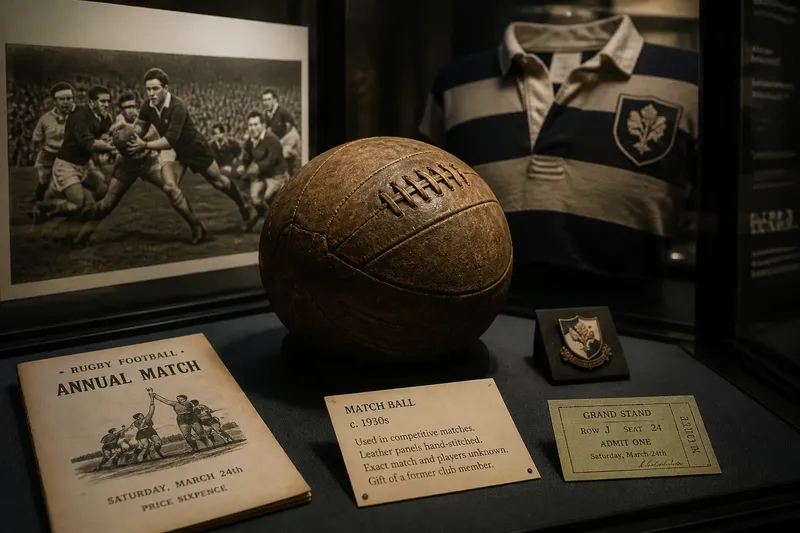
Imagine you choose a match ball in a cabinet beside an old photograph and a short label. The label identifies the ball as a match-used item but does not name the person who handled it. You notice its seam pattern and rubbed surface, then compare its shape with the ball in the photograph. You can reasonably say the display links equipment to the visible action of the game; you should not claim that the photographed ball is the same one unless the museum says so.
This kind of reading lets one item connect design detail with rugby’s wider setting without asking it to tell every story at once. A ball can prompt thoughts about handling, movement and the way equipment is made. A badge can lead towards questions of identity, while a ticket can suggest how supporters entered the matchday scene. The object’s own evidence sets the route.
Try writing a sentence in two parts: “I can see…” followed by “The display suggests…”. The first records an observable feature; the second marks an interpretation. Keeping those statements distinct makes your reading clearer and gives other visitors room to see something different.
What should you do when the display leaves gaps?
Do not treat a missing detail as permission to fill it with a familiar rugby story. A plain label may reflect limited surviving information, a deliberate focus on another detail, or a decision to keep text concise. You can still notice what is present: the object’s form, its neighbours and the words chosen to describe it.
If the museum has a catalogue or further information nearby, use it to check a question that genuinely matters to you. Otherwise, make a mental note of the uncertainty and move on. A display can be meaningful without offering a complete biography for every item.
Be considerate of other visitors as you look. Give people room at crowded cases, avoid leaning on display furniture, and follow any signs about photography or access. The object is easier to study when everyone can approach it comfortably.
How do you leave with a useful reading of the display?
Before moving on, name the detail you will remember and the reason it caught your attention. It might be a seam, a printed mark or the way an object sits beside a photograph. Then note one question the display answered and one it left open.
That small pause is enough to make a rugby museum display feel less like a row of relics and more like a set of choices you can read. Choose another object only when you are ready to begin again: label, detail, arrangement, then the wider game. A careful look often starts with the modest question of what, exactly, is in front of you.