Rugby Matchday Images Before and After the Replica Shirt
Rugby matchday images moved from portraits and programmes to replica shirts, showing how supporters could keep a club’s identity on paper or wear it.
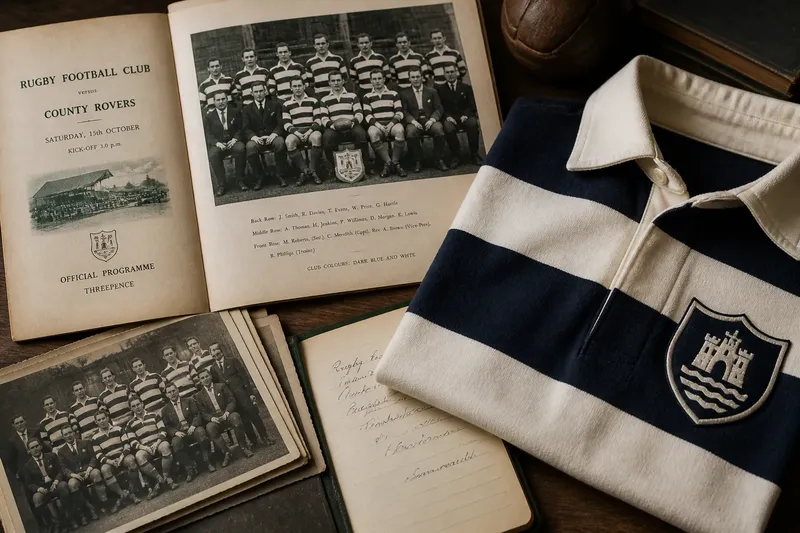
A folded programme could carry a team portrait home; a replica shirt could put the club’s colours on a supporter’s back. Rugby matchday images took both forms, and the change was not a simple handover from paper to clothing: each made club identity visible in a different way.
How did paper make rugby matchday images portable?
A supporter could see the players’ kit across the ground, but a portrait or programme offered a lasting image to keep. These printed objects also brought the team to people who had not attended the match, through local papers, family albums and club publications.
A posed team portrait presented players as a group, with rows of faces, matching jerseys and sometimes a ball or club banner. It favoured recognition over action: the viewer could study who stood together and how the club chose to represent its side.
Programmes connected an image to a particular fixture. Their pages could pair team names and match details with a photograph, crest or illustration, giving supporters a record of both the occasion and the club’s chosen presentation.
What did portraits and programmes each contribute?
A portrait put players first. The captain’s position, seated officials and grouped rows could suggest a hierarchy, while collars, bands and badges offered details that might be hard to see during play.
A programme supplied context around the image: the teams, ground, competition or occasion. Its design also reflected practical choices about space and printing. A small drawing or portrait might fit where a larger image would not, and fixture information could be changed for another match.
Neither object was a neutral record. A club could choose which names or images received prominence and whether it emphasised its own history, its opponents or the match itself. Read the picture alongside its caption and printed details.
How did the replica shirt change the matchday image?
A portrait or programme let a supporter keep an image of the team; a replica shirt let them wear a version of its visual identity. That shift changed the image’s setting. Instead of appearing only on a page or in a frame, the club’s colours and design could be displayed in the stands and beyond the ground.
The two forms also communicate differently. A photograph records particular people in a particular arrangement, while a shirt presents design features such as colour, stripes, collar and badge without showing the players themselves. A replica can make those features part of a supporter’s own appearance, though it should not be mistaken for the exact kit worn in a historic photograph.
Say a supporter has a programme with a monochrome team portrait and later buys a replica shirt bearing the club’s current badge. The programme preserves the pictured team and match context; the shirt displays a contemporary version of club identity. The observable result is two related but distinct images, not proof that the historic team wore the same design.
What can a printed rugby image tell you?
Printing changes what a photograph can show. A halftone reproduction turns tones into dots, and a small image may blur faces, folds or badge details. Paper, ink and later wear can soften the result further.
Monochrome images can show light-and-dark contrast or a stripe pattern, but they cannot reliably identify a jersey’s colour. A club’s present-day palette may seem like a clue, yet continuity should not be assumed from an old print alone.
Captions and surrounding material can help identify an image, but an undated photograph may have been cropped or reused with a later caption. Keep the distinction clear between what the object shows and what you infer from it.
What should you check before identifying an old rugby image?
Record visible details first, then decide what they support. For each observation, note the next action rather than turning a plausible guess into a firm identification.
- If a date is printed, transcribe it and compare it with the fixture details; if the date conflicts with other clues, record the conflict instead of choosing one.
- If a competition or opponent is named, write it down and use it to narrow the match identification; if neither appears, leave the fixture open.
- If a badge is legible, describe its visible shape and wording; if it is faint, record it as unclear rather than assigning a design.
- If the photograph has a caption, copy it and keep it linked to the image; if the caption may refer to another occasion, mark that uncertainty.
- If handwriting appears on the back or in an album, transcribe it and note where it sits; if it is unreadable, preserve that fact rather than guessing the words.
- If two prints share the same people and arrangement, compare their crops and printing; if the scene differs, treat them as potentially separate images until other clues agree.
Imagine you find an undated portrait in a family album. It shows a row of players, a ball and a banner, while the badge is too faint to read; the album page has no caption. First, note the album location and transcribe any writing nearby. Next, describe the visible arrangement and mark the badge as unclear. Then compare the banner and group with other identified club images, if available. The resulting record can say that the portrait appears connected to a club while leaving its date and badge unresolved.
Which questions help identify rugby portraits and programmes?
How can I date a rugby team photograph?
Look for a printed date, fixture reference, competition name or handwritten note, and record each clue separately. Kit style and photographic format may help narrow possibilities, but do not treat them as a precise date on their own.
Can a monochrome portrait reveal a club’s colours?
Not reliably. It can show contrast or pattern, but different colours may print as similar shades, so describe a colour only when another clear source supports it.
What should I record on an unidentified programme?
Transcribe the fixture details, wording and any printer information, then note the layout, condition and handwriting. If key details are missing, keep the identification provisional rather than filling gaps by guesswork.
Why do two copies of the same image look different?
One may be a crop or later reproduction, or may have been printed on different paper with different ink. Compare the people and scene before deciding that changes in sharpness or appearance mean a different occasion.
How can you preserve the image and its uncertainty?
Keep a record of the object as well as the scene it depicts: note inscriptions, captions, folds and visible damage. Avoid pressing folds flat, and seek suitable archival advice if the paper is fragile.
Rugby matchday images connect a team to the people who watched, collected or wore its identity. A programme can preserve the details of an occasion, while a replica shirt turns selected design features into something a supporter displays. When you describe either one, make clear what belongs to the object, what belongs to the pictured team and what remains uncertain.